Skip to Content

Test taking tips for anxious kids

Ten exam strategies and techniques for students with test anxiety
Symptoms of test anxiety (Art by Marina Avramenko)

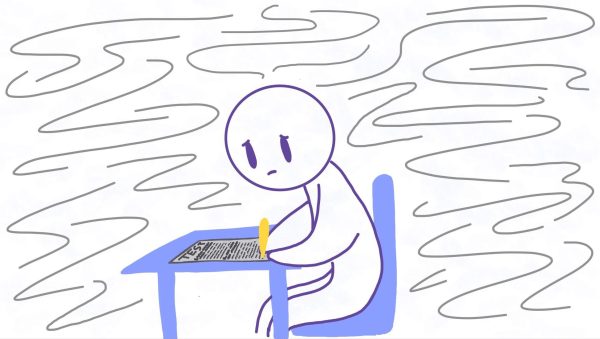
An anxious kid takes a test (Art by Marina Avramenko)


In a highly competitive school like Oak Park High School, tests are an integral part of student life. They are a standard way to assess how well students understand the material in their classes. However, some students suffer from test anxiety, a combination of physical symptoms and emotional reactions that interfere with a person’s ability to perform well on a test. This feeling is not foreign to OPHS. Here are some tips if you get sweaty during a stressful exam.

1. Get a good night’s sleep

Due to the large amounts of homework some students receive, especially when there is a test the next day, some students decide to go to bed later, at around 1 to 2 a.m., or even pull all-nighters to finish cramming. However, according to Magoosh.com, this can lead to difficulties with concentration, impaired memory recall, increased anxiety and clouded thinking. Junior Natalie Ng knows the importance of a good night’s sleep.


“When I do not get enough sleep, I often feel extremely tired the next day, which makes it difficult to stay focused,” Ng wrote to the Talon. “My concentration levels drop, and simple tasks feel more challenging. I can also become more irritable or anxious, and my memory does not work as well, making it harder to recall important information. In some cases, lack of sleep for me can also cause headaches or dizziness. I have noticed that over time, not getting enough rest can leave me feeling physically drained and emotionally exhausted.”

2. Arrive early

Some teachers will allow students to get ready early by setting up their supplies and filling out their information on a Scantron before the period starts. This can help decrease stress and give yourself time to get organized, relaxed and mentally prepared for the test to start. A blog by Summer.Harvad.edu stated that maximizing the time you have for a test–even if it is just a couple of minutes–helps students feel more comfortable, settled and focused during the exam. Junior Aditi Jain likes to arrive four to five minutes earlier on assessment days to give herself more time.


“It gives you more time to [settle] and get prepared for the test,” Jain said.

3. Maintain proper nutrition

An article from Foundationlearninggroup.com proposed that proper hydration leads to optimal cognitive function and overall well-being. It is also important in preventing dehydration, which can impair concentration, focus and memory. In addition, a nutritious meal that is rich in complex carbohydrates, lean proteins, healthy fats and fiber keeps students full and satisfied throughout the exam. However, avoid heavy, greasy foods because they may cause sluggishness or digestive discomfort. Junior Grace Popham can not start her day without breakfast and greatly values it. Her breakfasts are not the typical pancakes, though.


“I always eat breakfast because without it, I feel I would get more distracted during a test,” Popham said. “I [would] start thinking about how hungry I am because I have a very fast metabolism, so I get hungry really fast. So, if I do not eat breakfast by first period, I am absolutely starving. I try to eat something nutrient-dense. I have been liking egg whites. [Also,] I love steak for breakfast. Staying hydrated is a huge one. There are so many benefits for your skin [and] overall productivity. There are so many studies on how drinking water is so beneficial, but I definitely need to drink more.”

4. Take a practice test

One of the most useful tools in overcoming test anxiety is taking a practice test. Practice tests help give insight into the type of questions you may answer on the real test. They can also help identify areas of improvement. AP Biology teacher Winnie Sloan uses the College Board to give out practice tests and quizzes for her students because she wants to be certain every student has the resources they need to excel.


“I think it is very important when you take a practice test to put yourself in the same environment as the exam itself,” Sloan said. “I would encourage you to have your phone and all distractions put away and just focus on that practice exam, similar to what you would have to do in a classroom situation.”

5. Study ahead with a plan

Now, this may seem obvious, but one of the crucial factors in decreasing test anxiety is studying. Using active recall methods like flashcards instead of passive recall methods like re-reading your textbook helps you retain the information you need for the test. Active recall is more effective and efficient.


Furthermore, some students think that cramming for a test is more beneficial than studying little by little over time, but this cannot be further from the truth. Cramming does not promote long-term retention or complete understanding of the material. It relies more on memorization than learning, which leads to knowing the material but not being able to comprehend or apply the material. 


In addition, when you go to study, make sure you have an idea of what you want to accomplish by making a study plan. If you have four quizzes the next day, you want to avoid spending your time studying for only one quiz. Figure out how to schedule time for each subject and plan to do a little bit each day. For example, if you have a big history test on World War I, instead of studying for everything in one session, break it up into smaller sessions, focusing on the content within a 2-year chunk or specific battles. Another important aspect is breaks. It may seem better to study for eight hours uninterrupted, but breaks help to increase your energy, productivity, ability to focus and help prevent burnout. Sophomore Claire Kim uses flashcards for terms and solves practice problems for application questions. She thinks a study plan helps her greatly.


“I think it can definitely help you organize your studying and it can help you not freak out the day before, so you can just do [the assessment] at your own pace,” Claire Kim said.

6. Read the instructions carefully

Again, this may seem obvious, but in the middle of an exam, it may seem advantageous to skim the instructions to help save time for thinking. However, if you do not read the instructions fully, you may miss important details that can affect your score. You do not want to get an easy question wrong because you did not finish reading it. Junior Yuri Kim advises her peers to read the instructions.


“It is important to read the instructions because it is the key to making sure you get the right answer,” Yuri Kim said. “You have to be able to develop this skill of knowing what is important and what is not important in the instructions. Spend a moderate amount of time reading the instructions because a lot of people make silly mistakes [when] they do not read the instructions.”

7. Skip hard questions and return to them

The goal of a test is to finish it. If you spend all your time on a single question and you run out of time, your grade will be significantly impacted. So, if you skip the hard questions and answer the easier ones first, your grade may be higher. Mark down the hard questions and return to them at the end of the test if you have time. However, make sure that you put an answer in case you do not have time. Freshman Avery Calima skips the hard questions during a test based on her understanding. If she has time, she will return to them at the end and think it out.


“It gives you more time to really think about it (the question) and other questions in that quiz or test might help you if they have that same topic,” Calima said.

8. Check your work

There is no glory in finishing the test early, only in a job well done. Checking your work does take more time, but it can help you identify small mistakes in your work that could cost you points, like marking the wrong answer bubble on a scantron. 


In math, a misinterpretation of the equation or accidentally adding instead of multiplying can result in zero points. If you want to check your work in math, you can do the opposite operation, like multiplying the quotient by the divisor for division problems. Math teacher Jared Weintraub believes in the importance of checking your work.


“Checking your work for little mistakes is a good idea on a math test,” Weintraub said. “What I would do if I were a student is pass the test and try all the problems and leave some time to go back and check again, so you can revisit a problem with a different mindset. When you are doing a problem and make a mistake, it is hard to see that mistake in that moment and it is much easier to see it with fresh eyes. How you do that during a test is [to] try to look at [same problem during] different times in the test. Maybe even taking a break between the first pass and your check [to] try to get your mind in a different mindset so you can see the mistakes your brain made the first time.”

9. Relax

During the intensity of an exam, you may get nervous to the point where you start to blank out. If you experience this, it is okay to take a little break to relax. If you are rushing, slow down so your brain can grasp the information. You can wiggle your fingers, take deep breaths or picture yourself in your happy place. You could even stretch a bit to reduce stress and muscle tension. However, avoid distracting other students. Freshman Anika Gossain believes that taking breaks during a test reduces her stress levels and allows her to think better, therefore answer better.


“If it is a really long test, [I will] take like a two-minute break halfway and get water,” Gossain said.

10. CRAM Method

For multiple-choice tests, an effective method to use is the CRAM method:

  • C stands for cover the choices
  • R stands for read the question
  • A stands for answer the question without looking at the choices
  • M stands for match your answer to one of the choices

The benefit of this method is that it helps remove bias as a factor that affects your choices, especially primacy bias. Once you have your answer in your mind, it makes it easier to find the obviously wrong answers, bringing you closer to the right one. Senior Wynette Dea Macaraig believes this strategy helps her score higher on assessments.


“I think it helps,” Macaraig said. “You are using your own knowledge and not getting swayed by the answers because some of the answers can be tricky and it seems right and you choose the wrong one.”

Conclusion

Even though tests are huge stressors, they are a part of student life. The best way to deal with them is to face them head-on. Effectively preparing for a test can help reduce stress and anxiety and leave you with better chances of an A+.


Even if you do not perform well, tests do not define you. Humans are too complicated to be defined solely by a math test.

Donate to Talon
$535
$1500
Contributed
Our Goal

Your donation will support the student journalists of Oak Park High School - CA. Your contribution will allow us to purchase equipment and cover our annual website hosting costs.

More to Discover
Donate to Talon
$535
$1500
Contributed
Our Goal

Skip to toolbar